

From SGA1 to SGA2
From foundation building to ecosystem activation







Members spanning telecom, photonics, quantum hardware, infrastructure, cybersecurity and applied research.
QIATF in SGA1: building the foundations
Launched at Mobile World Congress 2024 in Barcelona, QIATF opened QIA’s work to the wider ecosystem. SGA1 established its foundations: the Technology Forum itself, the first Special Interest Groups, and the operational framework for ecosystem collaboration.
QIATF in SGA1: building the foundations
With SGA2, QIATF enters its next phase: accelerating industrial engagement, strengthening architecture and interoperability discussions, and connecting more closely with deployment-focused quantum internet initiatives.
The ecosystem continues to expand through new SIGs, annual community gatherings, and stronger alignment with QIA’s evolving technical roadmap.
How to join
From interest to active role in five steps
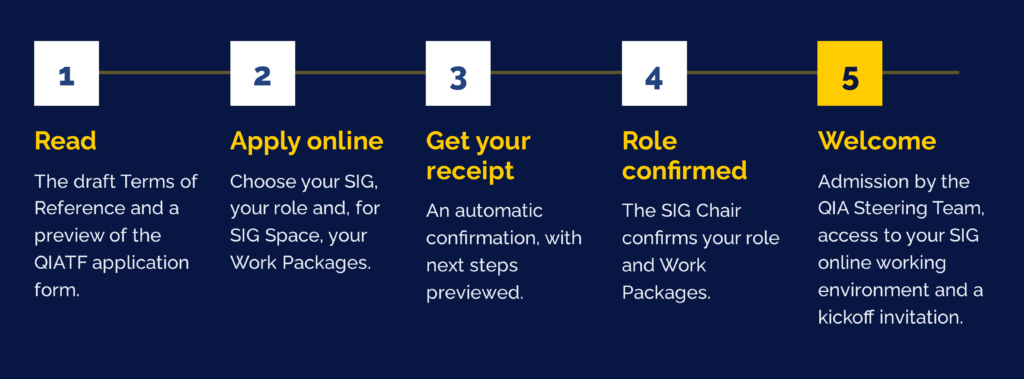
Join SIG Space
Express your interest in SIG Space
The SIG Space 2026-27 call for Work Package applications is open until 30 November 2026. Tell us which role you would like, and which Work Packages interest you. It takes about 10 minutes.
Interested in SIG Telecom or SIG Architecture? Write to QIATF-qutech@tudelft.nl and we will keep you posted.
Non-binding expression of interest. The revised QIATF Terms of Reference and the application form are under review by the QIA Steering Team and are expected to enter into force in Q4 2026. Roles and Work Package participation are confirmed by the SIG Space Chairs once they apply.Your data is processed by TU Delft for QIATF purposes only.
Documents
Everything you need, in one place
Draft documents, for information. The revised QIATF Terms of Reference and the application form are under review by the QIA Steering Team and may still change. Subject to final confirmation, they are expected to enter into force in Q4 2026. This page will be updated as soon as they are confirmed.
Read the draft Terms of Reference
Organisations already taking part in QIATF
Alongside the QIA partners. Logos shown with each organisation’s consent under the Terms of Reference.






















FAQ and contact
Questions before you apply
Not yet. The revised Terms of Reference and the application form are under review by the QIA Steering Team. Subject to final confirmation, they are expected to enter into force in Q4 2026. The versions on this page are drafts for information and may change before then.Are the Terms of Reference final?
No. QIA charges no participation fee. Participation is voluntary: you contribute time and expertise in line with your role.Does it cost anything?
Any legal entity that supports QIATF’s purpose and intends to contribute to at least one SIG. Organisations from outside the EU are welcome; every application is assessed case by case under EU law, export-control and sanctions rules.Who can join?
No. QIATF membership does not make you a member of QIA or a participant in a QIA Grant Agreement, and it does not give access to QIA Background or Results.Does membership make us a QIA partner?
You keep full ownership of your intellectual property. QIATF is not a confidential environment, so share only what you are entitled and willing to share.What happens to our IP and confidential information?
Yes, at any time on request, in line with each SIG’s participation arrangements. A role can differ from one SIG to another.Can we change role later?
Under the draft Terms of Reference, you become a QIATF Member automatically once they enter into force. Tell us your role in each SIG; until it is confirmed you hold the Observer role. You can withdraw within 30 days of being notified.We were a Core, Adopter or Associate Member. What now?
Yes. A Member acting, or intending to act, as Doer submits a preliminary SIG request; the QIA Steering Team decides within six weeks.Can we propose a new SIG?
Contact box
Still have a question? The QIATF team replies from its dedicated inbox.