20.04.2026Stories
Two Winners, Two Visions for the Quantum Internet

Two standout projects highlight how the quantum internet is being built and what it could become
Our third annual Quantum Internet Application Challenge has officially come to a close, with the jury making the unusual decision to recognize two winning submissions… each standing out in a different way. Together, they capture both sides of progress in quantum networking: building the underlying infrastructure, and imagining what might one day run on top of it.
This challenge, which was launched in 2023, invites students and researchers to move beyond theory and explore what a future quantum internet could actually do through hands-on simulation and prototyping. This year’s outcome reflects not only the strength of the submissions, but also the growing breadth of ideas shaping the field.
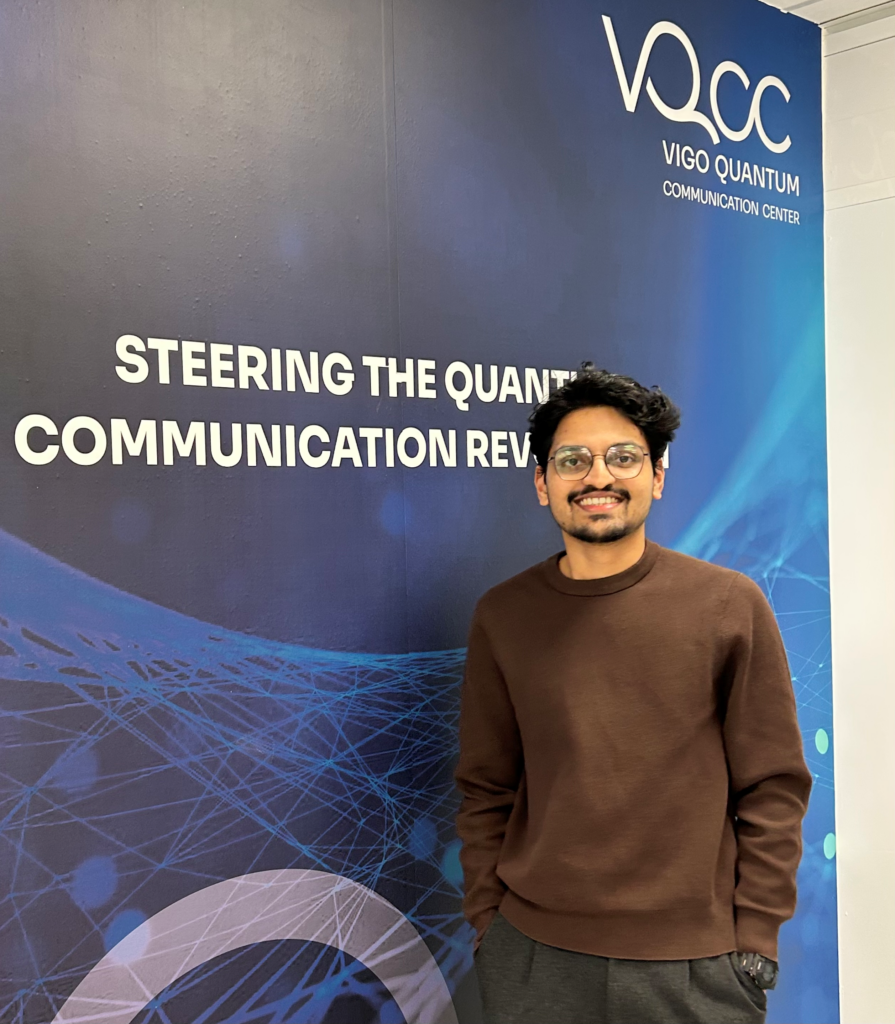
Meet Vaisakh Mannalath
Vaisakh Mannalath is a PhD researcher at the University of Vigo, working at the Vigo Quantum Communication Center with Marcos Curty. His research focuses on the security of quantum key distribution, particularly finite-key analysis and statistical methods in security proofs. He also works on quantum foundations, quantum random number generation, and quantum networks, and is part of the Marie Skłodowska-Curie Doctoral Network Quantum-Safe Internet.
The jury praised the project for its clarity and execution, noting that it provides “a clear and well-structured demonstration of multi-path routing using a minimum-cost flow approach,” implemented as “a clean and compact SquidASM application.” They also highlighted how it “delivers exactly what it sets out to do,” with “straightforward documentation and an implementation that runs smoothly right out of the box.”
That clarity is part of what makes the work impactful. As the jury observed, the simplicity of the design makes it “an effective and accessible example for exploring routing behaviour in quantum-network simulations,” while still showing “solid technical understanding and attention to detail.”
For Vaisakh, the experience was also about grounding theory in practice.
“It was very satisfying to take something I had mostly encountered at the theoretical level and actually see it implemented and simulated.”
His work points to the invisible backbone of future quantum networks, the systems that will quietly manage resources and enable applications like secure communication, distributed sensing, and precise synchronisation.
To check out Vaisakh’s project, click the button below.
Github for Quantum Networks with Minimum Cost Aggregation
Rethinking How We Use Quantum Data: Benedict Mullins
Ben Mullins, a first-year mathematics student at the University of Oxford, approached the challenge from a very different angle: focusing not on the network itself, but on how we might use it.
His project, Quantum SQL for Distributed Quantum Neural Networks, introduces a framework for querying and training quantum models across distributed quantum databases. Inspired by classical SQL, it reimagines how structured data access could work in a quantum setting.
Meet Ben Mullins
Ben Mullins is a first-year undergraduate student reading Mathematics at the University of Oxford. His academic interests include quantum computing, quantitative trading, and type theory with an emphasis on program correctness. He also has broader interests in the philosophy of science, problem solving, group theory, and combinatorics.
“I’ve entered the Quantum Internet Application Challenge for the last 3 years.”
Three’s a charm... also in quantum!
From “Quantum Proprioception” to energy teleportation, and now Quantum SQL, Benedict Mullins has built a track record of bold, unconventional ideas.
Each submission explores a different edge of what quantum networks could make possible.
“I enjoy clarifying my ideas, then building and testing them and, most importantly for me, the challenge sets a clear deadline that forces me to complete the project in a way that other people can appreciate.”
The jury was particularly struck by the originality of the idea, highlighting “your approach to bringing structured data access concepts into a quantum networking context,” alongside “the solid technical implementation demonstrated in your prototype.”
In their full assessment, they described the submission as “a highly creative and ambitious approach to defining an SQL-like interface for distributed quantum data,” supported by a codebase that is “clean, thoroughly documented, and demonstrates an impressive range of quantum techniques integrated into a unified framework.”
They concluded that the project stands out for “its imagination, scope, and technical execution,” offering “a compelling proof-of-concept that opens interesting directions for future exploration.”
Ben’s inspiration comes from the scale of modern artificial intelligence.
“I realised that a new query language will be needed for quantum databases,” he said, drawing parallels with how classical neural networks are trained across massive, distributed systems.
His work offers a glimpse into a future where quantum machine learning operates across networks in much the same way—only with entirely new capabilities.
To check out Ben’s project, click the button below.
Github for Quantum SQL for Distributed QNNs (QSQLNet)
Two Pieces of the Same Puzzle
While very different in focus, the two winning projects are deeply complementary.
Vaisakh’s work addresses the question of how quantum networks can function efficiently and reliably. Ben’s explores what those networks might ultimately enable once they are in place.
Both perspectives are essential—and together, they highlight the breadth of innovation needed to bring the quantum internet to life.
As Ben put it: “The future of quantum intelligence shouldn’t belong to the few; it should belong to the network.”
Both winners get to choose between a research visit or internship (up to €5,000 EUR) at one of the following QIA partners: Delft University of Technology, the University of Parma and Sorbonne Université.
Other notable submissions
- QuantumSync6G: Quantum-Assisted Time Synchronization for 6G Networks by Ethan Feldman
- QEDL — Quantum-Entangled Distributed Ledger (ESC + Hash-Linked Blockchain) by Hugo Christian Ojeda
- DistributedQC: Scaling Quantum Computation Beyond Single-Chip Limits by Varada Dhabe
- SecureQuantumProtocols: Anonymous Transmission and QSDC Implementation by Tomoya Hatanaka
- Caligo: Finite-Size Security in the Noisy Storage Model by Alessandro Da Ros
- Quantum Network OS with MAML Meta-Learning by Nandini Gantayat
We will launch this year’s Quantum Internet Application Challenge in the fourth quarter of the year. So, stay tuned!