17.12.2025Stories
Building skills for Europe’s Quantum Future: the QIA 2025 Internship

Bringing together students and researchers from physics, engineering, and computer science
The QIA Building for One Europe Internship Programme targets emerging researchers from European countries where there are no QIA partners yet to contribute to our scientific and technical work towards building a global quantum internet. The 2025 cohort reflects the programme’s emphasis on hands-on research, cross-border collaboration, and the development of early-career talent working at the intersection of theory, software, and experiment.
From distributed quantum computing to experimental entanglement sources, this year’s interns are contributing to a diverse range of projects while shaping their own research paths.
Meet the all-women QIA Interns of 2025
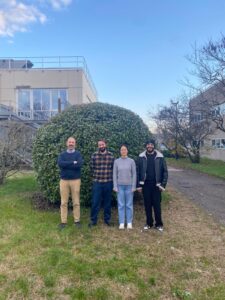
Gongyu Ni, a PhD candidate in Computer Science at University College Cork, is applying her doctoral research on machine-learning-driven scheduling to one of the key applications of quantum networks: distributed quantum computing. During her internship at the University of Parma’s Quantum Software Lab, she developed and evaluated new scheduling strategies, traffic models, and node-assignment methods within quantum network simulation frameworks.
“This project allows me to explore distributed quantum computing while strengthening my programming skills and deepening my understanding of quantum networks,” Gongyu says. She also highlights the importance of collaboration, noting that working closely with other quantum researchers has helped her refine ideas that may feed directly into future publications and her PhD thesis.
Read Full Story
Gongyu Ni is a PhD candidate in Computer Science at University College Cork, funded by Science Foundation Ireland. With an academic background spanning physics and quantum computation, her research focuses on machine-learning-driven scheduling, routing, and optimisation in quantum networks.
During her QIA internship, Gongyu’s work has concentrated on distributed quantum computing (DQC) as a key application of future quantum networks. She has been deeply involved in extending simulation and execution frameworks by integrating new scheduling mechanisms and traffic models. Her contributions include proposing novel schedulers for distributed quantum computing execution models, developing node-assignment strategies that account for heterogeneous quantum hardware, and implementing realistic Poisson traffic models to study network performance under varying loads. Through extensive simulations, she evaluated both newly proposed and benchmark scheduling strategies across different qubit configurations and job sizes.
Reflecting on the experience, Gongyu highlights the value of applying her doctoral research to a concrete and impactful use case. The internship has strengthened her quantum software development skills, supported the preparation of a final technical report and manuscript, and provided an opportunity to collaborate closely with a new group of quantum researchers. She describes the project as an important step in deepening both her technical expertise and her academic research trajectory.

Nadja Zoe Zaouri is a fourth-year Applied Physics student at the National Technical University of Athens, with a strong interest in experimental quantum technologies. Her internship at Sorbonne University focused on a compact, high-fidelity, telecom-wavelength four-qubit GHZ entangled photon source, combining literature review with hands-on exposure to laboratory work.
“The most valuable part of this experience was the speed at which I learned by being directly exposed to the experimental setup,” Nadja explains. Shadowing measurements and participating in source alignment helped her connect theory with practice and confirmed her commitment to pursuing quantum technologies in her future studies.
Read Full Story
Nadja Zoe Zaouri is a fourth-year Applied Physics student at the National Technical University of Athens, pursuing an integrated Master of Engineering with a focus on computational and theoretical physics and emerging quantum technologies. Her academic profile combines strong technical skills with interdisciplinary interests spanning machine learning, sustainability, and innovation.
Throughout her internship, Nadja focused on the study and characterisation of a compact, high-fidelity, telecom-wavelength multipartite entangled photon source, specifically a four-qubit GHZ source. Her work involved reviewing key research literature on the source’s operation and performance, as well as on quantum networking protocols such as anonymous communication and quantum sensing. In parallel, she gained direct exposure to experimental practice by shadowing laboratory measurement sessions and participating in the source alignment process.
Nadja emphasises that working directly with the experimental setup significantly accelerated her learning and strengthened her understanding of how theoretical concepts translate into real-world quantum systems. Collaborating with an experienced experimental research group confirmed her motivation to continue in the field of quantum technologies and to pursue further studies in this area.
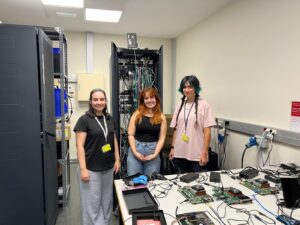
Elena Bresta, an Electrical and Computer Engineering student at the National Technical University of Athens, worked on integrating support for Quantum Charge-Coupled Device (QCCD) architectures into the Qoala execution framework for quantum networks in her internship at the Technical University of Valencia. Her background in computer engineering made the internship an opportunity to bridge classical hardware–software systems with emerging quantum processors.
“I wanted to gain hands-on experience in quantum software and understand how it connects to real hardware,” Elena says. “Being part of a research-active team and contributing to a framework that supports the quantum internet has been exactly what I hoped for.” The experience has reinforced her interest in pursuing further research in quantum computing architectures.
Read Full Story
Elena Bresta is an Electrical and Computer Engineering student at the National Technical University of Athens, currently completing an integrated MSc programme. Her academic interests lie at the intersection of computer engineering and quantum computing, with a particular focus on quantum machine learning and quantum neural networks.
During her QIA internship, Elena has been working on integrating support for Quantum Charge-Coupled Device (QCCD) architectures into the Qoala framework, an execution framework for end nodes in quantum networks. Her project addresses the practical challenges of controlling modular quantum hardware through software, contributing directly to ongoing research on scalable quantum computing and the quantum internet.
Elena describes the internship as an engaging and intellectually stimulating experience, highlighting the collaborative environment and strong connection between theory, software, and hardware. Her motivation for joining the programme stemmed from a desire to bridge her classical computer engineering background with the unique constraints of quantum processors. Looking ahead, the experience has reinforced her intention to pursue further research, potentially through PhD studies focused on quantum computing architectures and control systems.
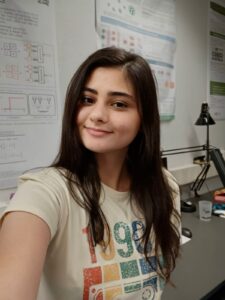
Ionela Balint is a Master’s student in Quantum Computing at the Polytechnic University of Timișoara. Based in Lisbon for the internship, she focused on multipartite entanglement distribution in quantum networks, studying how noise affects entangled states and exploring strategies to preserve fidelity across network nodes.
“This internship has been one of the most beautiful and valuable experiences of my life,” Ionela reflects. Beyond the technical work, she highlights the impact of mentorship, presentations, and journal clubs in building her confidence as a young researcher. The experience has strengthened her goal of continuing in academia and pursuing a PhD in quantum technologies.
Read Full Story
Ionela Balint is a computer science graduate and Master’s student in Quantum Computing at the Polytechnic University of Timișoara. With prior professional experience in data management, enterprise IT systems, and engineering internships, she brings a versatile and applied perspective to quantum research.
Based in Lisbon during her internship, Ionela has been working on multipartite state distribution in quantum networks, with a particular focus on mitigating the effects of noise on entangled quantum states. Her project examines fidelity and related performance metrics under realistic noise conditions, exploring strategies to preserve entanglement quality across network nodes.
Ionela describes the internship as a transformative personal and professional experience, marking her first time abroad and her first involvement in an international research group. She highlights the supportive research environment, strong mentorship, and opportunities to develop scientific communication skills through presentations and journal club discussions. Exposure to a wide range of research topics and seminars further broadened her perspective on quantum technologies. The internship has strengthened her commitment to pursuing a PhD and an academic research career in quantum science.
Together, the QIA 2025 interns illustrate the programme’s role in nurturing Europe’s next generation of quantum scientists and engineers and expanding the quantum internet expertise across the region. Through collaborative research and immersive projects, the QIA Building for One Europe Internship Programme continues to support talent that will help shape Europe’s quantum future.